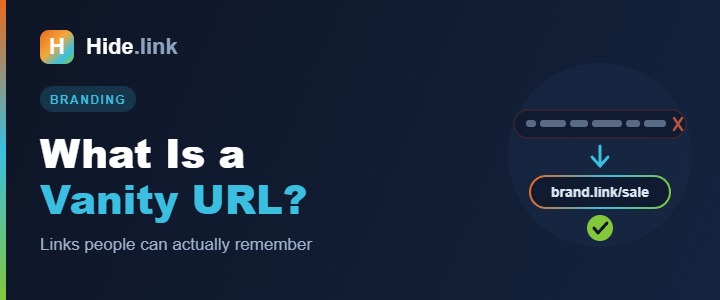
Try reading this out loud on a podcast: example.com/events/2026/q3/registration?id=8842&src=ep
Now try this: example.com/signup
That's a vanity URL. It's not a technical trick — it's a link written for humans instead of databases, and the difference shows up every time someone has to remember, type, or say it.
Definition
A vanity URL is a short, custom, readable web address created to be memorable and branded. Instead of a system-generated string, it uses words a person would actually choose.
You see them constantly:
bit.ly/nike-airmax— a custom alias on a shortenernike.to/airmax— a branded short domainexample.com/careers— a clean path on your own sitelinkedin.com/in/yourname— a personalised profile URL
All four are vanity URLs. The common thread is that a human chose the words.
Vanity URL vs short link — are they the same?
Related, but not identical, and people mix them up constantly.
- A short link is about length.
xyz.link/a8Kd2is short but meaningless. - A vanity URL is about meaning. It's usually also short, but the point is that it's readable.
The best links are both: short and readable. Most shorteners let you set a custom alias, which is exactly how you turn a short link into a vanity URL. (Here's how to shorten a URL if you're starting from scratch.)
Why they're worth the two minutes
People can actually use them
A vanity URL survives being said on a podcast, printed on a business card, read off a slide at a conference, or typed from memory the next day. A random string survives none of those.
They get clicked more
Readable links look safe. Random strings look like the links people have been warned about. When someone can see the destination described in the URL itself, the hesitation disappears — which matters more every year as people get more cautious about clicking.
They're free advertising
yourbrand.link/pricing puts your name in front of someone whether or not they click. Over thousands of impressions, that adds up.
They make your own reporting readable
This one is underrated. When you open your analytics in six months, /autumn-sale-flyer tells you what it was. /a8Kd2 tells you nothing, and you'll be reverse-engineering your own campaigns.
How to create one
On a shortener (fastest)
- Create a free account on Hide.link.
- Paste your long URL.
- In the custom alias field, type the words you want:
summer-sale. - Create the link. You now have
hide.link/summer-sale.
On your own domain (strongest)
Add a custom domain and your vanity URLs carry your brand instead of the shortener's: yourbrand.link/summer-sale. This is what large brands do, and it's the version that removes the trust question entirely.
What makes a good one
- Short. One or two words.
/pricingbeats/our-current-pricing-plans. - Say-able. If you can't read it aloud without spelling it, rewrite it.
- Predictable. Match what people expect:
/careers,/demo,/pricing. - Lowercase. Mixed case invites typos and some servers treat it as a different page.
- Hyphens, not underscores. Underscores are hard to see in an underlined link.
- No numbers if avoidable. Nobody knows whether "4" is a digit or the word.
Mistakes to avoid
- Reusing an alias for a new campaign. Old links in the wild suddenly point somewhere unexpected. Make a new one.
- Being too clever.
/gr8-dealzis memorable to you and confusing to everyone else. - Forgetting you made it. Keep a simple list, or your own analytics become a mystery.
- Using them for internal site navigation. Vanity URLs are for sharing. Link your own pages directly — see do short links hurt SEO?
The bottom line
A vanity URL takes about ten extra seconds to create and makes a link usable everywhere a random string isn't — out loud, in print, from memory. If a link is going anywhere near a human being, give it words.
Create your first vanity URL free — pick the words yourself.
Related reading: Custom domain short links · How to shorten a URL